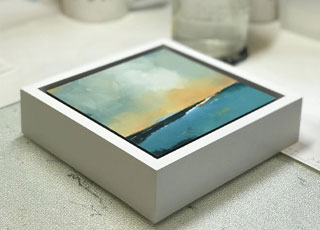
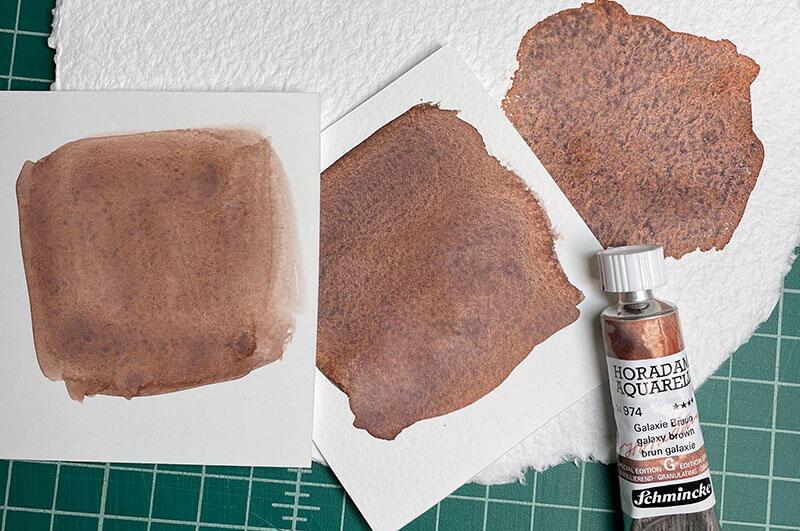
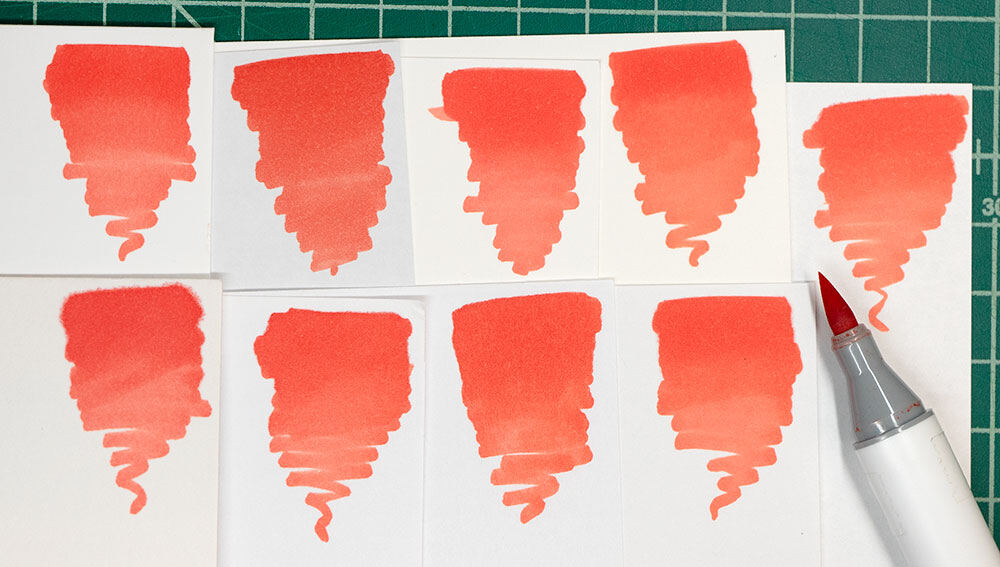
Painting has been in practice as a way of communicating since the beginning of time. From cave walls to canvas, artists have been recording history and art on almost every surface imaginable. With today's technology, artists are finding more and more new surfaces to paint on. Yupo is just one of many new and exciting substrates that is being utilized by artists who paint with various mediums.
Yupo is made from polypropylene pellets that are processed to form a sheet of very unique plastic. The surface is waterproof and has a super smooth bright white matte finish that is suitable for most painting mediums. It does not absorb the paint so it is very easy to wipe clean if desired. It is very durable as it will not stain or tear. Yupo is also acid-free and archival. As a synthetic paper, it is considered a green product, meaning it is made from renewable sources and is 100% recyclable. The fact that it is tree free makes it appealing to conservationists every where. Yupo was developed and is predominately used for the printing industry. It has the great ability to hold precise printing edges resulting in clear and clean graphics. This product, like so many others, was recognized by the art industry as a possible painting surface several years ago. However, until recently, Yupo was only used by a limited number of artist. These pioneering artists have successfully mastered the techniques needed to manipulate such a challenging surface.
George James is possibly the most well known Yupo artist. He paints mostly with watercolors and people seem to be his subject of choice. He uses several techniques such as tissue blotting, airbrush glazing, and also a squeegee to spread the paint across the Yupo surface. His paintings convey a very social and expressive message to the viewer. The colors are clean and set the mood for each work of art. George has several dvds available to curious artists wanting to perfect their use of Yupo. His work is recognized throughout the world.
Another recognizable artist that has mastered the Yupo surface is Taylor Ikin. Taylor has been promoting Yupo as a green product since she started using it. She expresses her desire to be earth friendly in her paintings hoping to encourage others to be conscious as well. Her artwork is well known in all areas of the country. She teaches workshops and also has several dvds available as well. Her technique is mainly a layering process where brush strokes are visible and well planned. Students, fortunate enough to attend her workshop, come away with more than just an artistic understanding of techniques. They also leave with a consciousness of how we, as artist, can lessen our footprint on the earth.
These and other artists are using every possible tool and most mediums to add texture and color to the Yupo surface. Traditional brushes, palette knives, art tissue paper, wire screens, rubbing alcohol and salt are all used to create wonderful and interesting paintings on Yupo. Several types of mediums, including watercolor, acrylic, pastel, collage, color pencil, crayon, and pen and ink can also be applied. Yupo is available in light, medium and heavy weights in the bright white finish, and also in the light and heavy weight translucent. It is produced in full sheets ranging in size from 20in x 26in to 26in x 40in and is also available in pads for smaller projects.
As more new materials and mediums become available, it is beneficial for us as artist to take advantage of these new possibilities. Trying something new helps us to broaden our experience and knowledge of art in general. We are then able to appeal to a larger community of art fans. So always be on the look out for those new and unusual uses for common materials around the house!
Happy Discoveries!

The holiday season is upon us. There are Thanksgiving turkeys to prepare and Christmas shopping at the mall. A time when family and friends are getting together to celebrate the holidays with pumpkin pies and homemade dressing, and those special recipes that are passed down from generation to generation.
The cool fall weather brings back wonderful memories of making apple butter in a great big copper pot in my grandmother's backyard. There were basically two times a year that you would harvest apples for making apple butter, the early summer and the late fall, and with each season there was a specific recipe. The summer apple butter was usually made with red cinnamon candy. The fall apple butter was made the old fashioned way with spices. The apples were gathered from the orchard as they ripened, then stored in the cellar until it was time to make the apple butter. They were peeled on an old timey crank apple peeler making the chore much easier. Then the apples were cut up and tossed in the copper pot. We took turns stirring the apples as they cooked over an open fire. The smell that rose from the pot was heavenly! After the apples were reduced to a thick boiling slurry, they were pressed through a sieve with a wooden mallet leaving just the tart apple sauce.
Now, a basic apple butter recipe consists of nutmeg, cinnamon, and cloves, however, every family has their own secret recipe of just the right spices and just the right amount of sugar to make theirs the best. My grandma perfected our family recipe long ago, and no one has had the nerve to alter it since!
After the spices were added, the apple butter was allowed to “cook down” or thicken, stirring constantly to keep it from burning. When it was done, the big pot was removed from the fire, and the apple butter was put into the jars. The whole family had a hand in the making the apple butter. There was a job for everyone, no matter how young. The jars were filled and then heated in boiling water to seal the lids. The jars were then set aside to cool. This gave time for wonderful stories and even roasting marsh mellows over the camp fire! The best part of the whole day was dividing the jars for each family to take home. My mom would make the best homemade biscuits to go with the apple butter. We called them “cat heads” because they were so big! Yum! Yum! We had enough apple butter to do us through the winter as well as some to share with neighbors!
This was an annual tradition that brought the whole family together and kicked off our holiday season. Traditions are important to families everywhere. They are wonderful ideas and practices that enhance the lives of all that participate. Having traditions help to pass on the family's history to the next generation and gives a sense of closeness to young family members. In this day and time when our lives tend to be very fast paced and families seem to spend less time together, it becomes more important to preserve these special traditions. I think growing up in the mountains around my extended family was a very unique experience, and certainly left me with some wonderful memories. These memories make wonderful subjects for paintings as well. Capturing these traditions on canvas is another great way to preserve our history. These are visual reminders of those great times and soon become family heirlooms as well. Family history can be handed down in so many ways, from story telling and writing to painting and even teaching a lost art. Whether it is for passing on traditions or preserving family history, sometimes it's just nice to look back and remember the good ole' days! Happy Memories!
The Fall season gives us plenty of reasons to be outside. With the cooler weather and the turning of the leaves, this is a great time for plein air painting. The French term plein air literally means “in open air”. Painting in the open air has been enjoyed for centuries. Artists like Monet and Van Gogh are well known for their landscapes painted on sight. Painting on location is quite different than painting in the studio. You will have to carry everything you would normally have at home along with you. This may include an easel, painting supplies, a stool, and sometimes an umbrella. You will want these things to be as compact and light weight as possible. You will also need to be concerned with your well being as well. You might want to pack sunscreen, a hat, comfortable shoes, water, and even something to snack on. Just think of it as a painting picnic!
This may seem like a lot of stuff to carry, especially if you are painting at a remote area requiring you to walk or hike to the location. However, a well designed travel easel can help to keep things organized. Now, I have tried many types of plein air easels. They come in several sizes and styles to fit the needs of any artist no matter what medium you use.
The original French easel is a very compact design that enables you to carry your materials right inside the box. This easel was designed by Roger Julian in 1945. It has a sketch box design with ample storage and three legs that fold out and extend to accommodate an artist who is standing or sitting. It is of wood construction and very durable. This is probably the most popular design for a plein air easel. There are other easels that are similar, like Cheap Joe's American Journey Field Series Sketchbox Easels. This easel has a painted metal drawer insert as well as a shoulder strap and magnetic legs snaps. These are just a few improvements from Julian's original design. The French easel comes in a full-box and also a smaller version, the half-box. This easel design can weigh from 9-13 lbs on average. It will be a little heavier when storing your supplies inside.
There are other compact plein air easels that do not have the extra storage and are much lighter weight. They are usually made from aluminum and can be easily stashed in a trunk for spontaneous use! Some of them come with their own carrying case making it easy to carry. These are very simply designed giving you basically, a canvas support mast and legs. That's pretty much it! But that's really all you need.
Now while design is important, stability is more important. Most of the field easels are tripods or have three legs. This can be a disadvantage if you are painting on unstable ground or in windy conditions, as the easel could easily tip over.
Recently, I was asked to test drive a brand new field easel design. This was an exciting offer and i was ready to put it to the test! The Joe Miller Signature Field Easel was designed by Cheap Joe himself. Being a watercolorist, Joe just got too frustrated with the old problems of standard field easel designs. Some were too big, some were too small, some were not stable enough, and some didn't have enough working space! Joe designed this easel with the watercolorist in mind, however, it is great for any medium. There are four legs, not three, giving you great stability no matter where you set it up. I took mine to the beach and unfortunately this late in the year the winds can be a little unpredictable. The legs are made of light weight aluminum with locking snaps that easily allows you to adjust the height of the easel. They also fold up nicely right up against the box to make it more compact. The easel is of a landscape orientation, as it is wider from side to side than from front to back. This is fairly unique, as many box easel designs are just the opposite. The field easel measures 17" x 12.5" x 7.25" and weighs in at about 10 lbs. empty. The canvas holder has two adjustable masts, to give you a canvas height of between 10 in. and 26 in. There are three working shelves, a left, a right, and one right down in front, with plenty of room for all your painting stuff. The easel is made from Beech wood and is available in two finishes, Cherry and Black. There was only one issue that I considered unfavorable. There is very little storage space on board. The box itself is only about 1 inch deep because of the shelves. There is enough space for paint tubes, brushes and other small items. This, however, did not outweigh all of the great advantages of this very remarkable field easel. Besides, most of us carry a small tote with all our stuff in it anyway! All in all, I give Joe's new easel two thumbs up!
What ever type of plein air easel you choose, the main thing is that you get out there. The early morning and the late evening are the best times for painting. This is when the light is the most dramatic. The light is very direct and strong, casting wonderful highlights and shadows. Making value sketches will be very important when designing your views. It is best to take time to walk around your subject at different angles and sketch several compositions. This is useful when deciding what your painting will look like. The light changes very rapidly and you will lose your initial design very quickly. You will want to quickly record as much of the scene as you can. The preliminary sketches will also be very instrumental as your scene changes. You may want to take a snapshot with your digital camera for reference as well. The painting is your interpretation of what you see. There is no right and wrong way. Having your easel and painting supplies set up in advance will make it easier to begin painting as soon as the design is complete.
Plein air painting is very different than painting from a photograph. The colors and depth of space is understated in a picture. Painting what we truly see and not what we think we see is what gives our painting life. Monet said, "When you go out to paint, try to forget what objects you have before you, a tree, a house, a field or whatever... merely think here is a little square of blue, here an oblong of pink, here a streak of yellow, and paint it just as it looks to you, the exact color and shape, until it gives you your own naive impression of the scene before you." This is a great lesson as a landscape can be very overwhelming with a lot of details. This concept helps you to simplify the scene until you have only what you need to convey your idea to the viewer.
Painting outside should be a personal experience of which you will grow from inside. The viewer of your art will be able to see you within your painting. Approach anything with passion and direction and you will be seen as well. Happy Plein Air Painting!
I was recently asked by a customer, what is the difference between tempera paint and watercolor. She went on to say that they are both water based and are both resoluble, however, the two are very different, in deed! Let us begin with the definition.
Tempera paint is defined as paint that consists of dry pigment and a glutinous water soluble binder, usually some type of sizing. This could refer to several types of paints, including egg tempera, made with egg yolks ,as well as caseins, which are made with milk. These paints can be perishable when in liquid form, however, when they cure they can last for hundreds of years.
This type of tempera is not what my customer was referring to. She was talking about poster paint, which is also a type of tempera that uses a gum water or glue based sizing for its binder. The pigment is usually a colored powder, unlike watercolor, which uses natural pigments and minerals that can be hazardous. Poster paint is great for use in children's projects as it is non-toxic and washes out very easily. You can buy it as a liquid or as a dry powdered paint. It is very inexpensive and unfortunately can fade over time.
As for Watercolor paint, it is a more dependable medium. It is formulated to be light fast and has a high concentration of pigments. Professional watercolors are designed to last for years without fading. The basic make up of watercolors in general is as follows:
1) Concentrated dry pigments - natural pigments and minerals- These are usually by-products of the auto industry, which mines the pigments for their auto paints.
2) Binder- Gum Arabic - The vehicle in which the pigment is distributed with.
3) Plasticizer - Glycerin, which softens the gum arabic and helps it to re-dissolve.
4) Humectant - corn syrup or honey- which helps the paint retain its moisture.
5) Extender - Dextrin- a filler which bulks out the paint without diluting the color. In a student grade paint, there is more of this filler and less pigment, making the paint more affordable.
6) Dispersant - keeps paint from clumping
7) Water - which suspends the pigment and vehicle and carries it to the paper and then evaporates to leave the paint adhered to the paper.
The basic concentration of pigment in watercolor paint is 20% to 50% pure pigment. This is determined by the degree of tinting ability in the pigment itself. Colors like the Phthalos and Alizarin Crimson require a less percentage than colors like Ultramarine Blue and most yellows. The rest of the percentage is what holds the paint together and keeps it moist. Watercolor paint is designed to be controlled by the water itself. The way you apply the water and pigment determines the results. It is very important as watercolorist that we use the best quality materials that we can afford. This will help to ensure the success of our paintings.
Different mediums are developed for different uses. They are best used for what they were designed to do. Therefore, and in conclusion, although poster paints and watercolor pigments have some similarities, they are ,however, very different mediums! Art comes down to creating, creating requires being inquisitive, and questioning the properties of mediums brings to us many new and wonderful discoveries and techniques. Happy Discoveries!
Tricks and Treats for Using a Mask:
Watercolor artists everywhere have their own ideas about how to preserve whites. The white areas of your painting provide highlights as well as what artist's call sparkle to your painting. It is exciting to see light areas against dark areas. This brings interest and continuity to your composition.
The purist actually avoids painting over the white areas of their watercolor painting, allowing the pure paper color to be used as the whites. This is known as negative painting and can be quite difficult for beginners and novice painters.
Planning is your first key concern when preserving the white areas. A value study is an essential step in planning your watercolor painting. This exercise enables you to see the lightest and the darkest areas of your subject. Which in turn helps you to preserve your whites by avoiding the area, or by using a mask.
There are several ways to mask out or preserve an area. First,you can use masking fluid which is designed to resist the watercolor paint and then be easily removed when the painting is complete, revealing the white paper beneath. Masking fluid, frisket, maskoid, drawing gum, it's all pretty much the same material. There are several brands and it really is a trial and error process to find the one that works best for you. However, there is very basic information for using masking fluid that is pretty much universal.
1) Always use an inexpensive brush to apply the masking fluid. This is because masking fluid can dry in the brush and this will ruin it.
2) Wet the brush in water before dipping into masking fluid. This makes it easier to clean the brush after use.
3) Apply masking fluid to dry paper only. It is best to test the masking fluid on a small spot to ensure that it will lift easily. Frequently cleaning your brush may be necessary throughout this process.
4) Masking fluid is meant to be a temporary application,you should only leave it on for short periods of time, usually between 1-3 days at the most. It will eventually become permanent if left on too long and you will not be able to remove it.
5) Make sure the masking fluid is completely dry before painting over. You can speed the drying time by using a blow dryer.
6) Only when your painting is completely dry may you remove the masking fluid areas with a masking fluid pick up, which is a rubbery type of material made for this purpose.
7) Masking fluid does leave a hard edge that is sometimes undesired. These edges can be softened by softly scrubbing with a moist brush.
8) Masking fluid has a limited shelf life, usually about 6 months to a year. It is best to buy smaller amounts to avoid having it dry up. It is possible to thin the fluid with ammonia but that is only if it is still in a liquid state.
Frisket Film is another product available for masking and is a great alternative to liquid masking fluids. The dry film is prepared on a translucent backing paper to make it easy to see where you are applying the mask. Just place the film over the area and burnish. This will leave the film only in the areas that are burnished. It can also be removed with a masking fluid pick up.
Rubber cement has been around for years and is also used to mask. The application is similar to masking fluid, however, rubber cement is a lot thicker and harder to work with. It can be more cost effective if you are covering larger amounts of area.
Artist tape is good way to mask larger areas as well. This is usually an acid-free white paper tape with low tack adhesive, available in ¾ inch, 1 inch, and 2 inch sizes. You can also remove some of the tack or by placing the length of tape on an article of clothing such as jeans, and then place it on the watercolor paper. This helps the tape to be removed without damaging the paper surface. Artist tape can be torn or used as a straight edge. Masking tape is not recommended for watercolor use as it is not acid free and it can also allow the paint to seep under the edges.
Scraps of paper can also be used to mask out interesting areas. You can keep the paper in place by taping from underneath or by using a repositionable spray adhesive. Just make sure the adhesive is applied to the underside of the paper and is completely dried when you place it on your painting.
Wax is another method of preserving whites. This, however, is a permanent masking method. Once you apply the wax, either in a crayon or pencil form, it can be rather difficult to remove completely. You can scrape the hardened wax off but it does leave enough residue to resist the watercolor paint. It is possible to sand or scrub the area although this can damage the surface of the paper. Because of its permanency, wax is a great way to preserve reflective whites such as highlights.
These are just basic examples of ways to preserve the white areas of your watercolor painting.
The best way advice is to experiment on a scrap piece of paper with the different techniques and document the process. This will enable you to reproduce the process on your painting. These masking techniques can also be used with other mediums as well, such as airbrushing and acrylics. Also, just remember, if all else fails, there's always white gouache! Happy Painting!
Vacations are a great way to get away and see the world, or maybe just explore your own back yard! I recently visited the southern coast of North Carolina, specifically, the Oak Island/ Southport area. This was a great trip with lots of wonderful views of the area. As an artist, everything became a subject for a new painting!
The beaches this time of year are pretty vacant, but you may still encounter some beach combers looking for shells or surf fisherman looking for a bite.The pelicans cruised the shoreline and the sand pipers plucked sand fleas from their burrows in the sand. Sketching is a great way capture the essence of your vacation. It is wonderful to be able to share the sights with all of your friends and family.
I took along my Kilimanjaro Watercolor Paintbook to record all of my travels for the week. This is one of my favorite travel companions and quite a unique journal. The paintbook comes with 20 sheets of 70lb. sketch paper alternated with 20 sheets of 140lb cold press watercolor paper. It is also available in 300lb cold press watercolor paper, with 10 sheets of each. The sketch paper gives you ample space to record value sketches and notes on your day. Paintbooks come in the original bright white paper as well as natural. They also come in a variety of sizes. The spiral bound pads allow the freedom of working flat or one page at a time, and the standard sizes makes it easy to pull out a favorite painting or sketch and pop it into a frame for great souvenir. Also you can create post cards from your pages and clip and mail them to all of your friends and family back home, or even better, use the Kilimanjaro Baby Block, which is the perfect 4x6 size required for post cards! Either way your love ones will want to know how much fun you are having while you are away! (note to the wise, find the local post office quickly upon arriving at your vacation destination, as my postcard arrived the same day I got back!)
I took my paintbook along with me to the beaches and also to the local lighthouses. Oak Island is home to one of the seven lighthouses in North Carolina. It is an active lighthouse that provides ships with a bright beacon, warning them of the shallow waters of the shoreline. Large tankers are still escorted by pilot boats that help them navigate through the tight passage between the sandbars and the shoreline. The Bald Head Island lighthouse is a close neighbor to Oak Island. Nicknamed Old Baldy, it is the oldest of the NC lighthouses, having been built in 1817. It was decommissioned in 1935 and is now a historic attraction of the island. It is open to the public and with 108 steps to the top, it was quite the climb. The view from the tower windows, however, was well worth the effort! You can see the entire island from the top. It is very close quarters up there, so make sure you are very good friends with anyone you are sharing the view with!
The next time you plan a vacation, don't forget your art stuff! While your packing, why don't you try out one of Cheap Joe's very own Kilimanjaro Paintbooks. You'll wonder how you ever traveled without it! Happy Journaling!
With the turning of the leaves and the dropping of the mercury comes festivals galore! This is the time of the year when people start to gather in large crowds all over the country. The month of October kicks off the holiday season with hundreds of celebrations across the nation.
Festivals and Fairs have been around for a long time as a way for neighbors and families to celebrate the Harvest Season. Farmers and homemakers would have the chance to display their goods for sale and competition. Judges were looking for the biggest pumpkin, the largest steer, and the most delicious jars of jelly, among hundreds of other categories. Today, craftspeople, musicians, and artisans take center stage at festivals. Showing off their talents and sharing their wonderful works of art with the multitudes. There are games and competitions, music and dancing, and who can resist those fried apple pies and funnel cakes! Ooooo Weeee! It seems as though there is a festival for everything.
In our area, we have the Valle Fair in Valle Crucis, The Wooly Worm Festival in Banner Elk, and The Octoberfest of Sugar Mountain. You can even visit Dorothy and Toto at the Autumn at Oz weekend at Beech Mountain. We have the Festival of the Frescoes, and the Whitetop Mountain Molasses Festival. The Todd New River Festival and the Brushy Mountain Apple Festival. Throughout North Carolina they are celebrating everything from mums with the Mumfest to barbeque pork at the Lexington Barbeque Festival. There is the Pumpkin Fest and the Dog Day's Out, Nascar Days, and the Oyster Festival, The Mountain Festival and the Fall Festival in the Pines. There's the High Kite Festival, and the Great Grapes Festival. You can even go down south for the Down East Festival,or hear great jazz at the Jazz Festival. There is the Cotton Festival and the Mullet Festival, the Autumn Leaves Festival, and the Mountain Glory Festival,and also the Peanut Festival. The NC State Fair draws the biggest crowd in the state and is the lengthiest of all the festivals. There so much to do and see that there is a festival for everyone!
You can visit your local Chamber of Commerce website to find out what is going on in your area. Festivals are a great way to get out and see your neighbors and do some early Christmas shopping! You may even want to enter your Grandma's recipe for Wild Blackberry Jam. Sounds like a Blue Ribbon winner to me!
What do blocks, sheets and elephants have in common? Why, watercolor paper, of course! Yes, even the elephant! Watercolor paper comes in various sizes and shapes. The choice is yours! So, How do you decide?
A standard sheet of watercolor paper measures 22 inches by 30 inches according to the British Imperial Standard. This was determined back in 1836 by British Royalty. It was established as a way to ensure that every manufacturer had the same dimensions for each size paper. These same standards are still observed today. Other sizes were determined at the same time, including the Single Elephant measuring 25 ¾ inches by 40 inches and the Emperor which is the largest sheet size at 40 inches by 60 inches. These larger sizes of paper are favorites among abstract artists.
The weight of the paper is another factor to consider when choosing your watercolor paper.
The most common weights are 140 lb. and 300 lb. The weight indicates how thick or heavy the paper is. It is calculated by weighing a ream (500 sheets) of paper. A ream of standard sized heavy weight paper weighs 300 lbs., hence, 300lb paper. There are other weights available including 200 lb., 90 lb. and also the single elephant. Because of its larger size, the single elephant weighs in at 260 lbs, however, the thickness is actually compared to that of 140 lb. paper, which is probably the most widely used weight.
Watercolor paper comes in various textures which are called “presses”. This refers to the way the paper is prepared after it is taken from the mold. There is hot press, cold press, rough, and also soft press. (the images shown here are from the Arches paper mill) The hot press paper is passed between two heated rollers which irons out all of the texture and creates a very smooth surface. This is desired when you have a lot of fine detail in your painting and also when using pen and ink. The cold press paper is passed between rollers with no heat. It is also called “Not”, which refers to being “not hot pressed”. It is a medium texture that is appropriate for most watercolor techniques. This is probably the most versatile and popular of all the textures. Rough press is actually not pressed at all. It retains all the texture that is produced when the paper is removed from the mold. This is a great texture to use for landscapes as you do not have to simulate the natural textures of trees and rocks. Rough watercolor paper is not as popular as the other presses. The last and least known texture is soft press. It is in between hot and cold press and has a velvety texture. This is a nice change from the cold press when you still need some light “tooth” to the paper.
You also have a choice in color. Watercolor paper comes in two basic colors of white. Bright white, which is compared to copy paper white, is a great choice when painting with bright colors such as with florals. Also, natural white, which is an off white, and works especially well for landscapes and portraits.
You can now choose which weight, texture and color, but what about what form to buy? There are sheets, pads and even blocks available. You know about full sheets, and probably have used pads of paper in the past. Blocks, however, are not as well known. A block is a stack of watercolor paper that is glued on all four sides. It has a small space usually at the top that is not glued which allows you to separate the pages. The advantage of a block is that it is pre-stretched, meaning it will not allow the paper to wrinkle or buckle when a large amount of water is used. After the painting is complete, allow it to dry thoroughly, usually overnight. Then remove the painting from the block by inserting a palette knife between the first and second sheets and pull it around the edges and back to the top, releasing the top sheet. Blocks are available in many standard sizes including 9 x 12, 12 x 16, 18 x 24, and also a 4 x 6 postcard size, which is great for travel. Paint a picture, write a note on the back (Wish you were here!) , stamp, and drop in the mailbox! Instant greetings! Blocks come in 140 lb., cold press, hot press, and rough, and also the 300 lb.,usually in cold press only. They are convenient to use because you do not have to mount your paper to a painting board. This can save time and space especially if you are painting plein air! The only disadvantage over sheet paper is that you can only work on one painting at a time. This does not seem to be an issue as blocks are very popular!
Wow, who would have guessed there would be so much information about watercolor paper to consider! This is just basic information to get you started. It is really up to you to find which one works for you, and with so many choices, it can be quite expensive to try them all. That is why Watercolor Paper Sample Packs are available at Cheap Joe's. They give you the opportunity to try several of our most popular brands and types of watercolor paper at a really great price. This is a great way to find your favorite! For beginners, the most common choice for watercolor paper would be a 140 lb. cold press paper in natural white, probably in a block or pad. Cheap Joe's also has thier own brand in Kilimanjaro Watercolor Paper, which comes in sheets, blocks, and pads. It is important to purchase the best quality paper that you can afford. This will make your watercolor experience more successful and enjoyable, which is the real reason you took up painting in the first place! Right?
Quilts have been a family staple for hundreds of years. Much more than a cozy comfort in the midst of cold weather, many family traditions have been created around the giving of hand made quilts. Gifts for new brides and new mothers, to commemorate a new home or as a passing to adulthood. Quilts were often made by whole families including the menfolk. Each person leaving behind a part of themselves to be remembered for years and years to come.
There's another form of quilting expression being displayed throughout the countryside, with just the same type of remembrance being desired. Barn quilts are cropping up in more and more rural areas as a way to remember families and traditions. The notion of a barn quilt block was conceived by a woman in Ohio who simply wanted a lasting way to remember her mother, who was a quilter. The idea spread like wildfire across the states. Now in most rural areas, you are bound to come across one of these wonderful works of art.
In our area of North Carolina, there are many of these memorable masterpieces displayed along country roads winding in and out of the Appalachian Mountains. They are usually sponsored by the county's art counsel. You can find more information about the barn quilts in your area by searching for your local arts counsel on the web. Local artists and barn owners team up to design and create these colorful barn quilts. They are usually 8 feet by 8 feet in size and clearly visible from the road. Some websites have mapped out the Quilt Trail in their areas to encourage visitors to tour the local countrysides. There are some really remarkable quilt patterns. Some are traditional and some are unique.
There is the Blazing Star, and the Feathered Star, the North Carolina Star, and the Beech Mountain Star. Oh, lots of stars in them there hills. Kentucky's Twinkling Star was also spotted on the NC quilt trail. We saw the Moon Over the Mountain, and the Texas Blue Bonnet, and even the Wiseman's Windmill. The Mountain Laurel and the Mystery Flower Garden, A Sunflower Variation, as well as the North Carolina Lily, and the Tree of Life all reside along the way. The Circle of Courage gave us strength and The Mariner's Compass showed us the way. Among the Friendship Circle was The Child Before Us and Sarah's Song could be heard for miles around. The Log Cabin was ahead on the Delectable Mountains in which the Pines in Snowy Mountains swayed. The Bear's Paw was spotted in the Square within a Square with Storey's Star shining above. The Battleship Barn and the Water Wheel, The Sawtooth Variation, and the Double After. The Leymoyne Cheesebox, The Empty Spool, The Triple Star, And who could forget the time honored Double Wedding Ring Quilt.
Now thats only a start and only in a small area of the country. There are way too many to list, but what a great story they tell! Each one is representative of the character and honor of the people who created them. Barn Quilts are jewels of the community and should be shared with all generations. Go online and print off maps of the Quilt Trail in your area. Reserve a day to slow down and leisurely enjoy the drive down the roads where these beauties live. Wave at the neighbors as you go by and give them a pat on the back for a job well done! And if you really get caught up in all the creative excitement you might want to try one yourself! Contact and participation information can be found at your Local Arts Council Website. I'm sure there is a barn just yearning for its own quilt block in your area. Why not leave a wonderful part of yourself behind for generations to enjoy and appreciate!
We get a lot of calls from beginning artists, particularly watercolorists. They are excited about getting started, perhaps taking a class, and want the best materials they can afford. Watercolor paints can be a big investment, and most beginners want all the wonderful colors they can get! But is that always the best choice?
Most teachers recommend a basic color palette. However, they all have their own idea as to which minimum colors are needed. A basic palette consists of a warm and cool of each of the three primary colors, red, blue and yellow. There are several choices in each of the six classifications. This is just one possible choice:
How can a color be warm or cool? You say? Well, it's a matter of color theory. Red, Orange, and Yellow are considered WARM Colors and are associated with the sun, fire, heat. Blue, Purple, and Green are COOL colors and are associated with water, the sky, and foliage. However, there are warm and cool versions of the three primary colors. You can determine the temperature of a color according to the location of it on the color wheel.
A red chosen between primary red and orange would be a WARM red like Cadmium Red. A red chosen between the primary red and violet would be a COOL Red like alizarin crimson. And the same principal applies to the Blues and Yellows. The color choices will vary between brands. What you will have is six primary colors that will make just about any color you could need. There are other colors you can add to supplement your palette which may include Viridian or Hooker's Green, Raw Umber, and Burnt Sienna. Payne's Grey can also be added to strengthen the darker values.
A very useful resource for this information is Steven Quiller's book, Color Choices, Making Color Sense Out of Color Theory. Steven has done the research for us in this incredibly useful book. He has placed familiar color names where they would appear on the color wheel. He has also designed and included his own color wheel that will make you wonder how you ever painted without it! His color wheel can be transferred to his specially designed palette. A very unique design that represents a color wheel, making it a visual learning tool. This is a great combination to make learning color theory very easy! It also makes mixing your colors a breeze!
Learning color theory will enhance your use of colors in your paintings and allow you to make better choices when adding new colors to your basic color palette. It is recommended that you start with the least amount of colors needed to complete a painting. This teaches you to mix colors correctly and you will save a lot of money on what artist's call convenience colors. These are premixed colors that can usually be mixed by using the basic palette. Often they are purchased to avoid mixing colors each time when using a lot of the same color. Your painting will be more harmonious when your secondary colors are mixed from the basic color palette.
So you see, it is really as basic as this, and the choice is up to you. The more you know about color, the more exciting your paintings will be!